Garment hook and eye sourcing requires approval of a matched fastening and its installation, rather than a loose hook selected from a catalogue. For woven women’s dresses, blouses, skirts and trousers, these small components can affect how an opening sits and operates. Buyers should define the application, materials and sample checks before ordering. This guide covers hook-and-eye fastenings, not hook-and-loop tape or general button sourcing.
Identify the fastening and its location
Mark the fastening on the garment drawing and show whether it sits above a zipper, at a waistband or at another opening. Identify sewn-on or another attachment arrangement. Confirm whether the eye is a supplied matching component or a separately specified construction.
Record the supplier code and dimensions of both parts. Avoid treating every catalogue hook and eye of a similar size as interchangeable. The garment bill of materials should connect the complete fastening reference to the correct style and location.
Approve the matched components
Review the hook and eye together for engagement, clearance and the intended closed position. Identify material and finish requirements, visible color and any buyer-specific performance or chemical testing needs. Ask the component supplier to confirm the relevant evidence rather than assuming appearance proves suitability.
Check for obvious roughness, sharp edges, distortion or an inconsistent finish before sewing trials. Where a test requirement applies, agree the method and acceptance criteria with a suitable laboratory. This guide does not set a universal force target or claim that one component specification suits every garment.
Trial the attachment on actual materials
Request a sewn sample using the proposed shell, facing, waistband or other supporting layers. Approve attachment position, thread or installation arrangement and how the reverse is finished. Check whether the fastening distorts the fabric or creates an uncomfortable bulky area.
A loose component trial cannot show how a lightweight neckline or structured waistband behaves when assembled. Use the trim sourcing guide to retain the product references, then keep the accepted application sample with the garment approval records.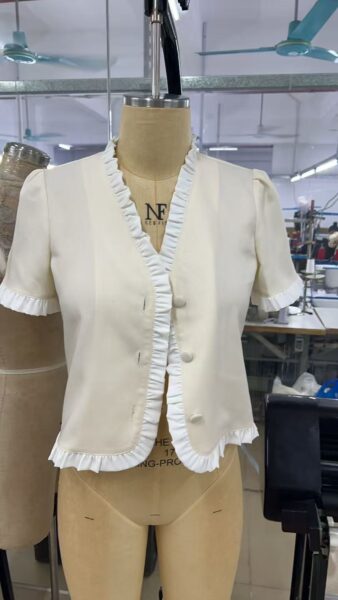
Check opening alignment and practical operation
Review the garment closed and open on the intended fit reference. Confirm that the edges meet as designed and that the wearer can engage and release the fastening. Look for overlap, gaping, snagging and unintended exposure of hardware.
If the opening is under excessive strain, investigate fit and construction as well as the fastening. A stronger component is not automatically the appropriate correction. Above a zipper, review both systems together using the woven dress zipper quality guide where relevant to the style.
Assess the agreed care and use conditions
Complete the buyer’s specified functional and care checks on the representative garment. Record changes in alignment, attachment, visible finish and operation. Keep the specimen and treatment identifiable so comments refer to the tested construction.
If the supplier proposes a different finish or product code, review the affected requirements before release. Similar dimensions do not establish equivalent behavior. Ask what new evidence and sample approval are needed, particularly where the component is visible or touches the wearer.
Order pairs and control substitutions
Confirm the purchasing unit: individual hooks, individual eyes, matched sets or another pack arrangement. Reconcile the quantities needed for each style and size, including any agreed spare components and pack rounding. Do not assume a delivery count covers both halves unless the unit is defined.
At receipt, check identification and separate unmatched or unapproved parts. Keep the hook and corresponding eye references linked when issuing them to sewing. Record who may approve a substitution and retain the old and revised references.
For a women’s clothing enquiry to Mugekoo, provide the garment drawing, fastening location, material layers and quantities. Ask the factory to confirm sourcing and attachment capability. Manage revisions through the production change control process so the components purchased match the application approved for bulk.
