How to Evaluate a Clothing Manufacturer Before Placing a Bulk Order
Choosing a clothing manufacturer is one of the most important decisions a fashion brand makes before placing a bulk production order.
A supplier may offer an attractive price, impressive product photos, and a low minimum order quantity. But these factors alone do not tell you whether the manufacturer can consistently deliver the quality, specifications, and production schedule your brand needs.
For fashion brands, startups, retailers, wholesalers, and private label businesses, the real question is not simply:
“Can this factory make my clothes?”
The better question is:
“Can this manufacturer reliably turn my specifications into consistent finished products at the required quality, cost, and delivery schedule?”
This guide explains what buyers should evaluate before committing to a bulk clothing production order.
1. Start With Manufacturing Capability, Not Price
Price is usually one of the first things buyers compare.
However, the lowest quotation is rarely enough to determine the best manufacturing partner.
A clothing manufacturer should first be evaluated according to whether its production capabilities match your product requirements.
For example, a manufacturer specializing in basic T-shirts may not be the right supplier for:
- Technical activewear
- Heavyweight streetwear
- Complex outerwear
- Structured jackets
- Embroidered garments
- Garments requiring special washing
- Complex cut-and-sew products
- High-end fashion collections
Before requesting a quotation, identify the manufacturer’s actual production strengths.
Ask questions such as:
- What types of garments do you produce regularly?
- What fabrics do you work with?
- What production techniques are available?
- Do you handle sampling internally?
- Can you develop patterns from technical packs?
- Do you offer fabric sourcing?
- Can you provide custom labels and packaging?
- What quality-control procedures are used?
A supplier that specializes in your product category can often reduce development problems later in the process.
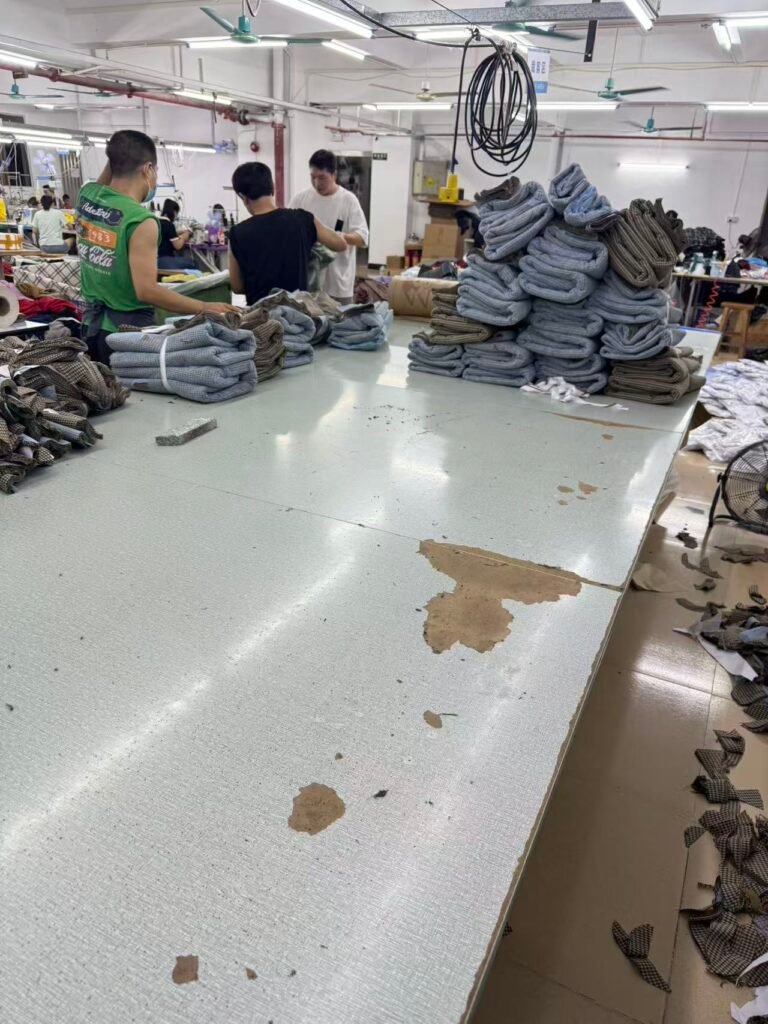
2. Check Whether the Factory Really Understands Your Product
One of the biggest mistakes buyers make is assuming that a supplier understands their design simply because the supplier says “yes.”
Professional apparel manufacturing involves much more than copying a picture.
A manufacturer needs to understand:
- Measurements
- Fabric composition
- Fabric weight
- Construction
- Stitching
- Seam allowance
- Trims
- Labels
- Printing
- Embroidery
- Washing requirements
- Color standards
- Packaging specifications
For example, if you are producing an oversized hoodie, “oversized” is not a sufficient production specification.
The factory may need to understand:
- Body length
- Shoulder width
- Chest measurement
- Sleeve length
- Hood construction
- Cuff dimensions
- Fabric GSM
- Shrinkage requirements
- Stitching specifications
The more precise the technical information, the lower the risk of misunderstandings.
3. Review the Manufacturer’s Sampling Process
Sampling is one of the strongest indicators of how a manufacturer approaches production.
A professional manufacturer should have a structured sample-development process.
A typical development process may include:
Design → Technical Specification → Pattern → Fabric → First Sample → Fitting → Revision → Pre-Production Sample → Bulk Production
Do not judge a manufacturer solely by the first sample.
Instead, evaluate how they respond when the first sample needs improvement.
A strong manufacturing partner should be able to explain:
- What needs to be changed
- Why the problem occurred
- How the pattern will be corrected
- Whether the fabric affects the result
- How the revised sample will be produced
This development process is especially important for brands creating original products.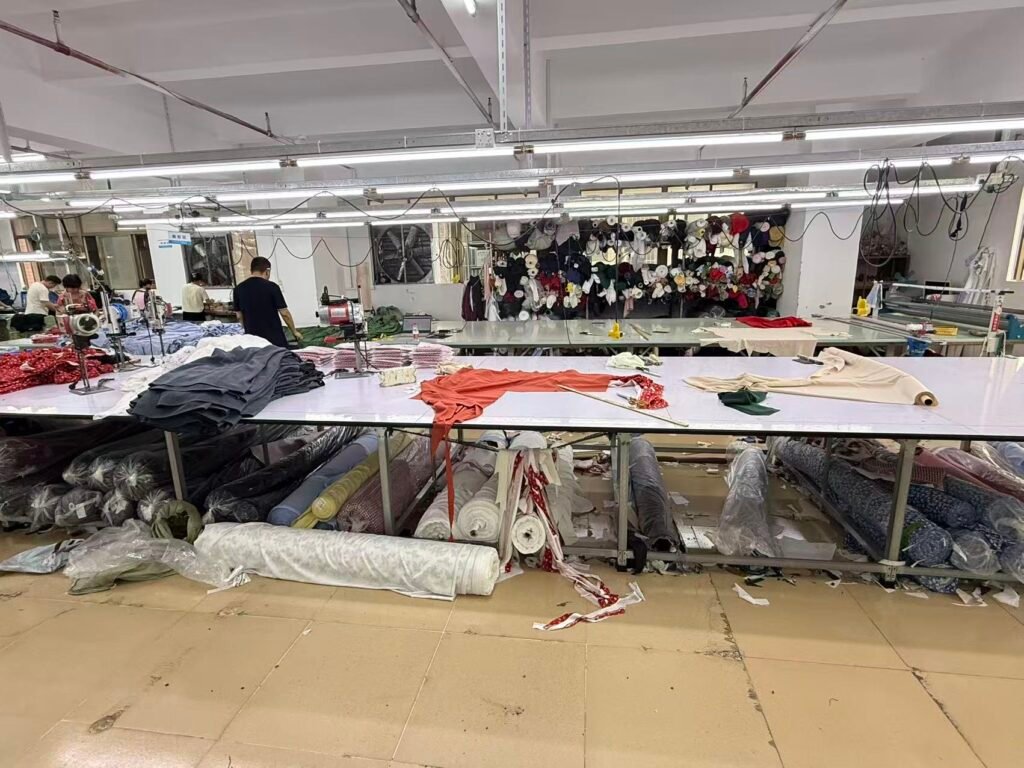
4. Understand MOQ Before Negotiating Price
Minimum Order Quantity, commonly called MOQ, is another important consideration.
MOQ can be calculated differently by different manufacturers.
For example, a supplier may define MOQ as:
- Units per style
- Units per color
- Units per size
- Units per fabric
- Units per production batch
Therefore, simply asking:
“What is your MOQ?”
may not provide enough information.
Instead, ask:
What is the MOQ per style, color, fabric, and size breakdown?
This gives you a much clearer understanding of the actual production requirement.
For emerging brands, flexible MOQ can be particularly valuable because it allows the company to test demand before committing large amounts of inventory.
However, buyers should also understand that very small production runs can increase the unit cost because fabric purchasing, pattern development, cutting, setup, and production preparation still require resources.
Current industry discussions continue to emphasize flexible production, smaller test runs, and faster product development for emerging apparel brands.
5. Compare the Complete Cost, Not Just the Unit Price
Two manufacturers can quote very different prices for what appears to be the same garment.
This does not necessarily mean one manufacturer is overcharging.
The difference may come from:
- Fabric quality
- Fabric GSM
- Composition
- Trims
- Printing
- Embroidery
- Packaging
- Labeling
- Production quantity
- Quality-control requirements
- Sampling costs
- Shipping terms
For example, a $6 T-shirt and a $9 T-shirt may look similar in a product photograph.
But the difference could be:
- 180 GSM vs. 240 GSM fabric
- Different cotton composition
- Different dyeing process
- Better rib construction
- Higher stitching quality
- Better shrinkage control
Therefore, buyers should compare quotations using the same specification sheet.
A useful quotation comparison should include:
| Cost Factor | Manufacturer A | Manufacturer B |
|---|---|---|
| Fabric | ||
| Garment production | ||
| Printing | ||
| Embroidery | ||
| Labels | ||
| Packaging | ||
| Sampling | ||
| Shipping | ||
| Total landed cost |
This prevents the common mistake of choosing a supplier based only on the lowest factory price.
6. Evaluate Fabric Sourcing Capability
Fabric is often one of the most important components of garment quality.
A manufacturer should be able to explain where fabrics come from and how fabric quality is controlled.
Important questions include:
- What fabric suppliers do you normally work with?
- Can you source custom fabrics?
- Can you match a physical fabric sample?
- Can you provide fabric composition information?
- Can you provide GSM specifications?
- How is fabric color checked?
- How is shrinkage tested?
- How is fabric inspected before cutting?
For brands developing custom apparel, fabric sourcing capability can significantly affect the final product.
A factory that has established relationships with reliable fabric suppliers may also be able to provide more consistent quality across repeat orders.
7. Ask How Quality Control Works
Quality control should not happen only at the end of production.
A better manufacturing process uses several checkpoints.
For example:
Fabric Inspection
Before production begins, fabric can be checked for:
- Color consistency
- GSM
- Fabric defects
- Width
- Shrinkage
- Composition
- Surface problems
Cutting Inspection
The cutting stage can affect:
- Garment dimensions
- Pattern accuracy
- Panel alignment
- Fabric direction
Sewing Inspection
Production teams should monitor:
- Stitch quality
- Seam strength
- Thread trimming
- Construction
- Measurements
Finished Garment Inspection
The final garment can then be checked for:
- Measurements
- Appearance
- Printing
- Embroidery
- Labels
- Loose threads
- Stains
- Packaging
A manufacturer should be able to explain its quality-control system clearly rather than simply saying:
“We guarantee good quality.”
8. Ask for Evidence of Previous Production
A manufacturer’s portfolio can help you understand whether it has relevant experience.
Look for examples involving products similar to yours.
For example, if your brand sells:
- Streetwear
Look for hoodies, oversized T-shirts, cargo pants, jackets, and similar products.
If you sell:
- Activewear
Look for leggings, sports tops, performance T-shirts, sports shorts, and technical garments.
If you sell:
- Premium fashion
Look for structured garments, high-quality fabrics, detailed construction, and specialized finishing.
The goal is not simply to find a manufacturer with many product photos.
The goal is to determine whether the manufacturer has relevant manufacturing experience.
9. Check Communication Before Placing the Order
Communication problems can become expensive production problems.
During the initial quotation and sampling stage, pay attention to how the supplier communicates.
For example:
Good Signs
The manufacturer:
- Asks detailed questions
- Identifies unclear specifications
- Explains production limitations
- Provides realistic timelines
- Communicates sample revisions clearly
- Documents important changes
Warning Signs
Be careful when a supplier:
- Says yes to everything without asking questions
- Gives extremely vague quotations
- Changes prices repeatedly
- Avoids technical questions
- Cannot explain production processes
- Promises unrealistically short lead times
A manufacturer that asks detailed questions before production may actually be a better partner than one that immediately promises everything.
10. Verify Production Lead Time
Lead time is another important factor that buyers should clarify before placing an order.
Ask the manufacturer to separate:
Sample Lead Time
from
Bulk Production Lead Time
and, where applicable:
Fabric Development / Fabric Sourcing Time
A typical production workflow may look like:
Order Confirmation
↓
Fabric Procurement
↓
Cutting
↓
Sewing
↓
Printing / Embroidery / Washing
↓
Finishing
↓
Quality Inspection
↓
Packing
↓
Shipment
This makes it easier to identify where delays could occur.
Do not rely on a single statement such as:
“Production takes 30 days.”
Ask what the 30 days actually includes.
11. Understand OEM, ODM, and Private Label Services
Different brands need different levels of manufacturing support.
OEM Manufacturing
OEM is generally suitable when the buyer already has:
- Designs
- Technical packs
- Measurements
- Materials
- Construction requirements
The manufacturer primarily turns the buyer’s specifications into finished garments.
ODM Manufacturing
ODM is more suitable when the buyer needs more product-development assistance.
The manufacturer may support:
- Design development
- Pattern development
- Fabric selection
- Product modification
- Sample development
Private Label Manufacturing
Private label production can involve manufacturing products under the buyer’s brand, including:
- Custom labels
- Hangtags
- Packaging
- Brand-specific details
- Customized product specifications
Understanding which service you actually need will make supplier selection much easier.
12. Ask About Custom Branding
For fashion brands, manufacturing is only part of the product.
Brand presentation also matters.
Depending on the manufacturer, customization may include:
- Woven labels
- Printed labels
- Hangtags
- Neck labels
- Size labels
- Custom packaging
- Polybags
- Stickers
- Care labels
- Custom cartons
Ask the factory to provide a clear list of available branding options.
This helps prevent unexpected costs later.
13. Check Export and Shipping Experience
If you are buying garments from China for international distribution, manufacturing capability is only one part of the supply chain.
You should also evaluate whether the manufacturer understands international shipping requirements.
Ask:
- Which countries do you regularly ship to?
- Which shipping methods do you support?
- Can you provide export documentation?
- Can you work with my freight forwarder?
- Can you arrange door-to-door shipping if required?
- What packaging specifications are available?
The ideal manufacturer should understand that international B2B apparel production involves more than simply producing garments.
14. Ask About Repeat Orders
Your first order is not necessarily the most important order.
For a growing fashion brand, repeat production is where consistency becomes critical.
Ask the manufacturer:
- Can the same fabric be reproduced?
- Are production specifications stored?
- Are patterns archived?
- Can the same measurements be reproduced?
- Can colors be matched on future orders?
- Can previous samples be referenced?
- How are changes to repeat orders documented?
A good manufacturing relationship should become more efficient over time.
The goal is to create a repeatable production system rather than starting from zero with every order.
15. Protect Your Product Specifications
When developing original apparel, your technical information can be commercially valuable.
Keep organized records of:
- Technical packs
- Measurements
- Patterns
- Fabric specifications
- Artwork
- Logos
- Packaging designs
- Sample revisions
- Approved samples
- Purchase orders
You should also clearly communicate ownership of your brand assets and product-development materials.
Professional documentation helps reduce misunderstandings and makes future production easier.
16. Build a Manufacturer Evaluation Scorecard
Instead of choosing a supplier based on intuition, create a simple evaluation system.
For example:
| Evaluation Category | Weight |
| Product Capability | 20% |
| Quality Control | 20% |
| Sampling Ability | 15% |
| Price | 15% |
| MOQ Flexibility | 10% |
| Communication | 10% |
| Lead Time | 5% |
| Export Experience | 5% |
Score each manufacturer from 1 to 10.
This creates a more objective comparison.
A factory with the lowest price may not have the highest overall score.
For many brands, a manufacturer with slightly higher production costs but better consistency and communication can create a better long-term outcome.
A Practical Checklist Before Placing Your First Bulk Order
Before making a production commitment, confirm the following:
- Product specifications are finalized
- Fabric specifications are confirmed
- Sample has been approved
- Measurements are confirmed
- Printing and embroidery artwork is approved
- Labels are confirmed
- Packaging requirements are confirmed
- MOQ is clearly understood
- Unit price is confirmed
- Payment terms are documented
- Production lead time is confirmed
- Quality-control standards are agreed
- Shipping arrangements are clear
- Final inspection requirements are understood
The more details that are confirmed before production, the fewer surprises are likely to appear later.
What Makes a Good Clothing Manufacturer?
A good clothing manufacturer is not necessarily the factory offering the cheapest price.
For a fashion brand, a stronger manufacturing partner should provide a combination of:
Manufacturing capability + quality control + communication + flexibility + consistency + realistic pricing.
The most valuable supplier is one that can understand your product requirements, identify potential problems early, produce accurate samples, maintain consistent quality, and support repeat production as your brand grows.
This is especially important in today’s apparel market, where brands increasingly prioritize flexibility, speed-to-market, and supply-chain control.
Final Thoughts
Selecting a clothing manufacturer should be treated as a supply-chain decision rather than simply a price comparison.
Before placing a bulk order, look beyond product photographs and low quotations.
Evaluate the manufacturer’s:
- Production capabilities
- Sampling process
- Fabric sourcing
- Quality-control system
- MOQ structure
- Communication
- Lead time
- Branding services
- Export experience
- Repeat-order consistency
A reliable manufacturer should not simply produce garments.
They should help turn your product specifications into a repeatable manufacturing process.
For fashion brands looking for a long-term OEM or private label manufacturing partner, this approach can reduce production risk while creating a stronger foundation for future collections.
Need help developing your next apparel collection?
Mugekoo works with fashion brands and businesses looking for custom clothing manufacturing, OEM/ODM production, private label apparel, and flexible production solutions.
Contact our team to discuss your product requirements, sampling needs, MOQ, and production plan.
Frequently Asked Questions
How do I know if a clothing manufacturer is reliable?
Review its relevant manufacturing experience, samples, quality-control process, communication, production capability, lead times, and previous production examples. Do not evaluate reliability based only on online reviews or low prices.
What should I ask a clothing manufacturer before ordering?
Ask about MOQ, pricing, fabric sourcing, sampling, production lead time, quality control, customization, labels, packaging, shipping, payment terms, and repeat-order procedures.
Is a low MOQ always better?
Not necessarily. A lower MOQ can reduce inventory risk, but very small production runs may have higher unit costs. The best MOQ depends on your product, budget, sales forecast, and production requirements.
Should I order samples before bulk production?
Yes. For custom apparel, approving samples before bulk production is one of the most important steps in reducing quality and specification problems.
What is the difference between OEM and ODM clothing manufacturing?
OEM generally means producing according to the buyer’s specifications, while ODM usually involves greater manufacturer support with product development, design, materials, or construction.
How can I compare multiple clothing manufacturers?
Use the same technical specification and quotation format for every supplier, then compare manufacturing capability, quality, sampling, MOQ, price, communication, lead time, and export experience.
Suggested internal links for Mugekoo:
- Custom Clothing Manufacturer
- OEM Clothing Manufacturer
- Private Label Clothing Manufacturer
- Low MOQ Clothing Manufacturer
- How to Choose a Clothing Manufacturer in China
- Clothing Manufacturer FAQ
- Contact Mugekoo
Primary SEO keyword: clothing manufacturer
Secondary keywords:
- clothing manufacturer China
- OEM clothing manufacturer
- clothing manufacturing company
- custom clothing manufacturer
- private label clothing manufacturer
- apparel manufacturer
- clothing factory
- bulk clothing manufacturer
- custom apparel manufacturer
- clothing supplier