Leftover fabric reconciliation closes the material account after a clothing production order. It explains how much fabric was received, used, held, returned or left in storage. Buyers who pay for excess mill quantities or supply their own fabric need this record before treating the remaining material as available for a reorder.
The task is different from reconciling finished garment quantities. A shipment can match the purchase order while the fabric balance remains unclear. A material closeout helps the brand distinguish reusable inventory, short remnants, quality holds and an unexplained difference in the records.
Agree the accounting basis before production
Identify who owns surplus material and what records the factory will provide. Use consistent units and distinguish purchased quantity from received quantity. If rolls are checked at receipt, retain those measurements and note differences from supplier labels rather than choosing whichever figure makes the balance appear correct.
The customer-supplied fabric guide explains the receiving handover. Reconciliation builds on that starting record. For full-package orders, agree whether the quotation includes material that becomes the buyer’s stock or whether the supplier retains it under the commercial arrangement.
Separate stock categories before adding totals
A balance of 80 metres does not establish that all 80 metres can be cut into another batch of dresses. The material may be split across dye lots, narrow remnants or rejected sections. Report continuous usable lengths separately from scrap, held stock and material awaiting a decision.
| Category | Useful closeout record | Reorder implication |
|---|---|---|
| Uncut usable rolls | Roll ID, lot, length, width and status | May support a new marker after verification |
| Reusable remnants | Individual length, width and condition | Suitability depends on panel shapes |
| Quality-held material | Reason for hold and affected quantity | Requires disposition before use |
| Cutting waste | Recorded measurement or agreed estimate basis | Do not count as garment-ready stock |
| Returned or transferred material | Dispatch and receiving record | Changes the stock location and balance |
Reconcile movement without counting it twice
Fabric issued to the cutting room is not necessarily all consumed. Some may return to storage. Establish whether the report uses net issue quantities or separate issue and return entries. Do not subtract both net usage and the gross issue that produced it.
Track development samples, laboratory specimens and recuts where they use the same purchased material. Identify allowances included in the plan and record actual use where available. Cutting waste may need an agreed estimation method, but it should not be invented as a balancing figure.
The fabric consumption guide provides the planning baseline. Compare it with actual output and material movement, then investigate differences in width, size ratio, matching requirements or approved changes.
Use a simple worked balance
Suppose a buyer’s receipt record shows 1,000 metres. Documented sample and testing use is 20 metres. Net material taken out of stock for production is 850 metres, including the recorded cutting and recut use. The expected remaining balance is 130 metres.
If the physical stock count shows 125 metres, the 5-metre difference needs an explanation. It is not automatically proof of misuse: a receipt measurement error, an omitted return or an unrecorded sample could be involved. Equally, do not dismiss it as normal loss without checking the agreed records. These figures are illustrative and do not establish an acceptable loss percentage.
Verify usable stock physically
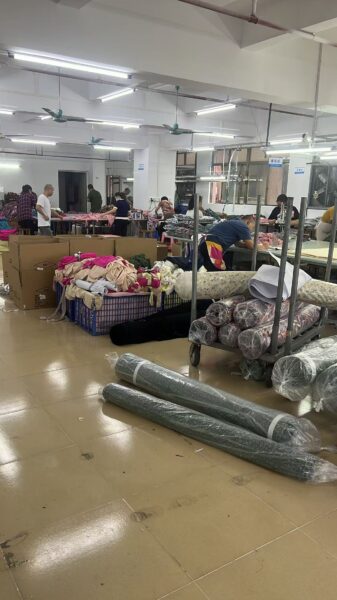
Ask for the roll and remnant list, storage location and labeled photographs where useful. The factory should record the material code, shade group and condition. An image of a pile of fabric does not establish meterage or cutting suitability.
Keep the identity chain through the material traceability workflow. Before reserving leftovers for a reorder, check whether the relevant continuous lengths and shade groups can support the required size and color quantities. A total across incompatible lots can overstate what is usable.
Record the closeout decision
Agree whether the material will be stored, returned, transferred or otherwise handled. State who pays any agreed storage or transport charge and when the stock will be reviewed again. If fabric is kept, record access, identification and protection requirements appropriate to the material.
Ownership and permitted use should be explicit. Paying a garment invoice does not resolve every possible surplus-material arrangement. Keep commercial decisions in the order documentation and do not authorize another use through an ambiguous message such as “deal with the leftovers.”
What to request with the final production handover
Request a receipt summary, documented material movements, remaining stock categories, physical balance and proposed disposition. Resolve an unexplained variance before closing the material account. This gives the next collection a credible inventory starting point.
For production with Mugekoo, supply the material purchasing arrangement and your desired closeout records with the order enquiry. You can send the development requirements to Mugekoo and ask how surplus stock will be identified, reconciled and handled after the garment order is complete.