Garment thread consumption is the amount of sewing thread needed for the approved construction and production quantity. It supports purchasing and costing, while thread selection determines which product is suitable for the garment. For OEM women’s clothing orders, a useful estimate separates operations, colors and thread types rather than assuming one fixed number for every blouse or dress. Buyers can request the estimate’s basis before approving material procurement.
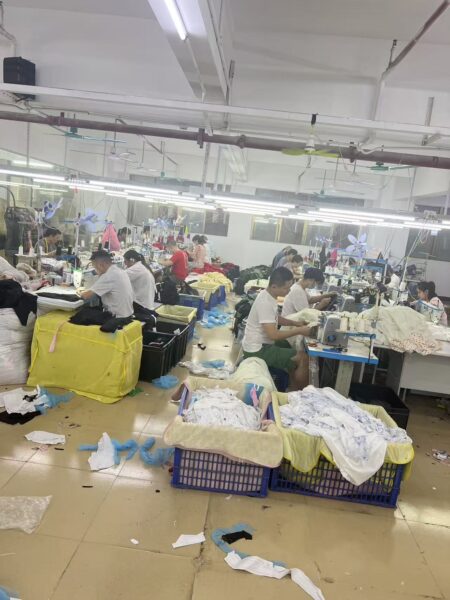
Start with the approved sewing construction
Prepare an operation list identifying the seam lengths, stitch arrangements and materials used. Include visible topstitching and edge finishing as well as assembly seams. Record which operations use different thread specifications or contrasting colors.
Make the calculation refer to a particular pattern and construction version. A later change from one seam arrangement to another can alter thread demand. Confirm the approved thread selection first, then calculate quantities for that product instead of using consumption as a reason to substitute an unapproved thread.
Use ratios that match the actual settings
Coats’ thread consumption guide describes two approaches: measuring thread used in a seam and estimating through consumption ratios. It identifies stitch type, material thickness, layer count and stitch density among the variables affecting demand.
A published ratio is a starting point with stated conditions, not a universal factor for every production setup. Ask the factory how its estimate was derived and whether representative sewn trials were used. Keep the approved stitch density connected to the estimate so a changed setting prompts review.
Calculate operations separately
For each operation, multiply the seam length by the relevant total thread-to-seam ratio, then add the operation totals. Keep measurement units consistent. Where top, bobbin or looper threads differ, separate the demand for each thread rather than combining them into one purchasing line.
As a hypothetical arithmetic example, 2 metres of a seam at a measured ratio of 3 requires 6 metres of thread. Another 1 metre at a measured ratio of 8 requires 8 metres. The combined demand is 14 metres before any allowance. Those invented ratios explain the calculation only; they are not production recommendations.
Represent the actual size and color quantities
Confirm how the calculation accounts for seam-length differences across sizes. Use the ordered size mix or another documented estimating basis, rather than assuming every unit is identical to the sample size. If different colors use contrasting topstitching, prepare separate color requirements.
Include all relevant operations and components. A blouse with a belt, for example, requires the belt’s sewing work to be counted. Use the garment bill of materials to keep thread specifications and color references aligned with the consumption worksheet.
Separate sewn consumption from ordering allowance
The thread present in completed seams is not necessarily the full amount needed on the production floor. Discuss an allowance for expected production losses and its basis with the factory. Do not apply a percentage without identifying whether it is already included in the quoted consumption.
Clarify the effect of small quantities, machine allocation and partially used cones. Rounding the total length to the supplier’s pack size does not always resolve the need to supply several machines at once. The ordering plan should explain how much is purchased, issued to production and expected to remain.
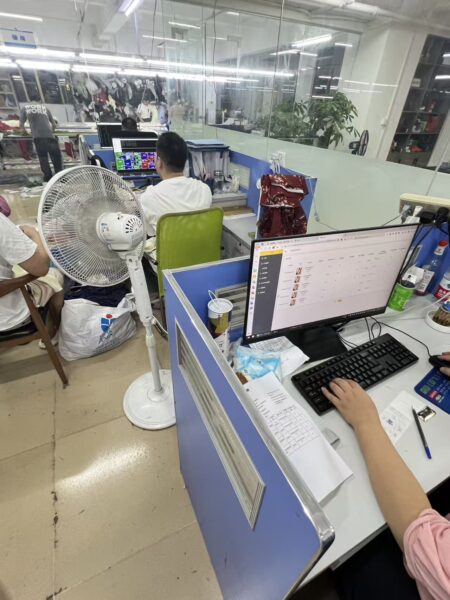
Check cone specifications and purchase units
Confirm the usable length per cone, thread product code, color code, supplier pack quantities and ordering unit. A price per cone is not directly comparable across different cone lengths or thread products. Keep product performance approval separate from a lower unit price.
Record any supplier minimum by color and whether the order can use stock colors or requires a custom match. Discuss ownership and handling of leftovers before purchasing additional material for a small production run. This makes the cost implication visible without assuming all ordered thread will be consumed.
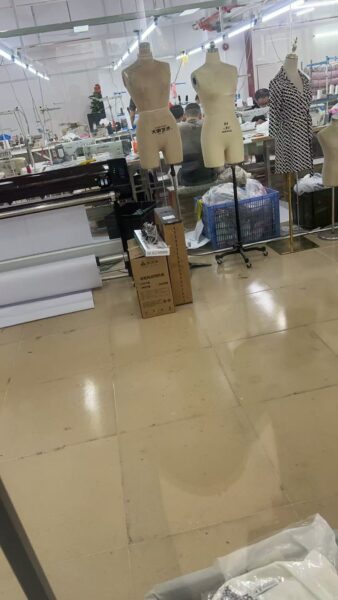
Update the estimate after an approved change
Review consumption if the pattern, seam length, stitch arrangement, density or thread specification changes. Keep the original and revised estimating bases identifiable. Compare actual issues and returns with the estimate after a representative production run to improve the next order’s planning.
For a women’s clothing quotation from Mugekoo, send the construction details, quantities by size and color, thread requirements and sample status. Coordinate revisions through the production change control process. A documented estimate supports sensible procurement without reducing approved seam quality to meet an arbitrary thread budget.